 Cgpt
Cgpt supports ChainGPT AI tools and grants governance rights through staking
Cgpt is ChainGPT’s utility token for buying AI credits and gaining governance rights through eligible staking pools. Its ticker is $CGPT. The platform includes a blockchain chatbot, smart contract generation and auditing, AI news and non-fungible token (NFT) creation. Paid requests consume credits, while staking points determine membership benefits and launchpad tiers. Free tools and direct credit purchases offer access without staking. Participation in a token sale also follows its registration and eligibility rules.
UpdatedIn short: Converting CGPT into AI credits is irreversible, while staking keeps tokens committed under the selected pool’s withdrawal rules.
AI tools, credits and staking points serve different purposes
ChainGPT’s AI applications produce answers, code and artwork; credits fund paid usage, while staking points establish membership benefits. The Web3 AI Chatbot answers blockchain questions. The Smart Contract Generator turns written requirements into contract code, while the Smart Contract Auditor examines submitted code for potential vulnerabilities. AI crypto news provides a news feed, and the AI Trading Assistant supports crypto market analysis. Developer APIs let applications call supported tools programmatically.
Before deployment with real funds, generated contract code needs compilation, testing and professional security review, while an AI audit supplies findings to examine without certifying the contract as secure. The AI NFT Generator creates artwork from text prompts. The Trading Assistant identifies historical chart patterns and estimates possible future formations across supported assets. Those forecasts do not establish a future token price. Liquidity farming has a separate rewards role.
The native token uses BEP-20 on BNB Smart Chain; bridged versions also exist on Ethereum and Solana. Network-specific contract or mint addresses identify those representations.
Can I use ChainGPT without staking CGPT?
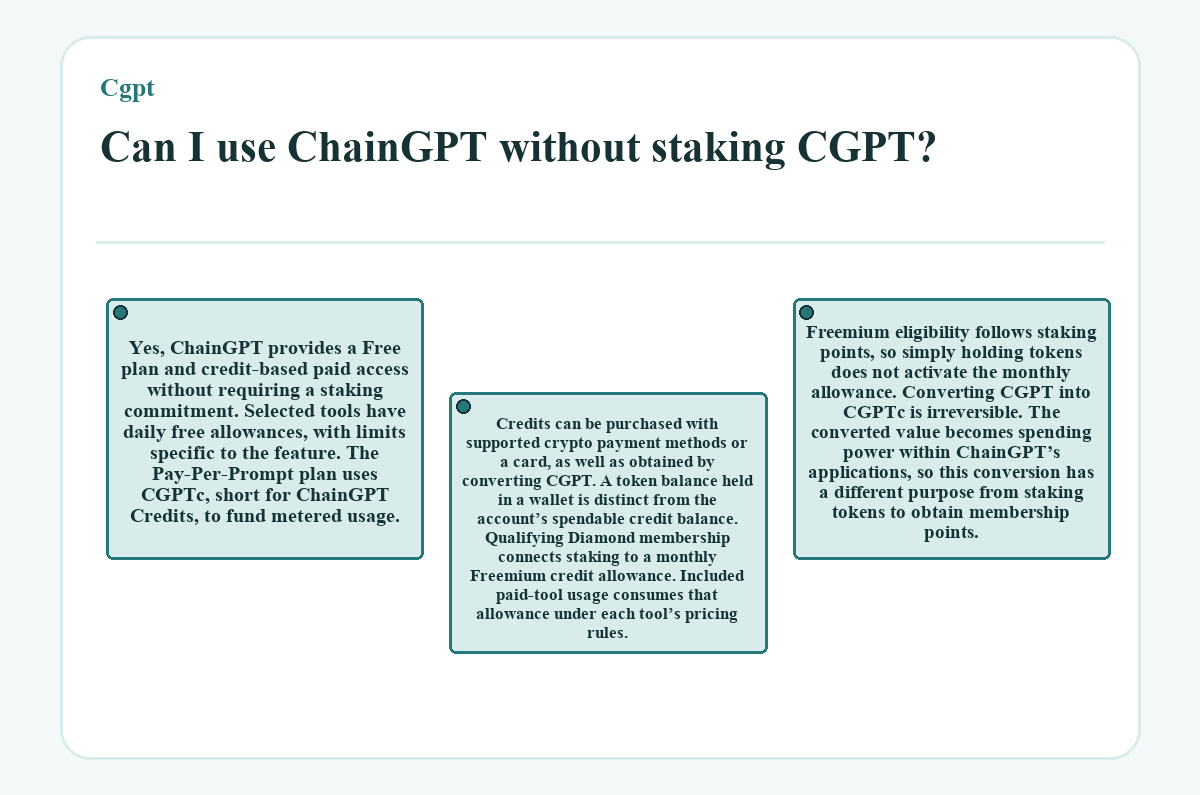
Yes, ChainGPT provides a Free plan and credit-based paid access without requiring a staking commitment. Selected tools have daily free allowances, with limits specific to the feature. The Pay-Per-Prompt plan uses CGPTc, short for ChainGPT Credits, to fund metered usage. Credits can be purchased with supported crypto payment methods or a card, as well as obtained by converting CGPT. A token balance held in a wallet is distinct from the account’s spendable credit balance.
Qualifying Diamond membership connects staking to a monthly Freemium credit allowance. Included paid-tool usage consumes that allowance under each tool’s pricing rules. Freemium eligibility follows staking points, so simply holding tokens does not activate the monthly allowance. Converting CGPT into CGPTc is irreversible. The converted value becomes spending power within ChainGPT’s applications, so this conversion has a different purpose from staking tokens to obtain membership points.
What determines the credit cost of an AI task?
The selected tool, its request options and the amount of usage determine credit consumption under the applicable plan. Quick and in-depth contract audits have different pricing categories. In the auditor API, enabling conversation history adds a usage charge because the service stores the interaction. NFT generation costs can vary with generation settings. The account’s credit balance shows spending capacity, while the tool’s pricing specifies the charge for the intended operation.
In this hypothetical case, an account prepares a smart contract audit request with conversation history enabled and a valid API key. Its credit balance is below the charge for that configuration. The service returns an insufficient-credit error for the submitted request. The message identifies the funding shortfall; no complete audit report has been received. Without a change in spendable credits or request cost, the shortfall remains.
Before retrying, the account receives enough credits to cover the chosen audit settings. The updated account balance establishes the available spending power; holding additional CGPT in a wallet alone does not fund that credit balance. Conversation history remains enabled, so its extra usage charge still applies. The request retains the same contract input and audit settings.
The retry in this example returns a complete streamed audit report. The receiving application reads the stream to its end and checks for errors or premature termination before treating the report as complete. An opened connection or a partial response alone does not establish delivery of the full report.
Staking assigns membership points while locking tokens
Staking commits CGPT to a selected pool and assigns CGPTsp, or ChainGPT staking points, under that pool’s terms. Staking points equal the CGPT amount committed multiplied by the selected pool’s multiplier. The multiplier reflects the pool’s conditions, including its lock duration. Longer commitments can receive higher weighting. The resulting points determine a membership tier, while the tokens remain subject to the pool’s withdrawal rules. Pool options and multipliers can change.
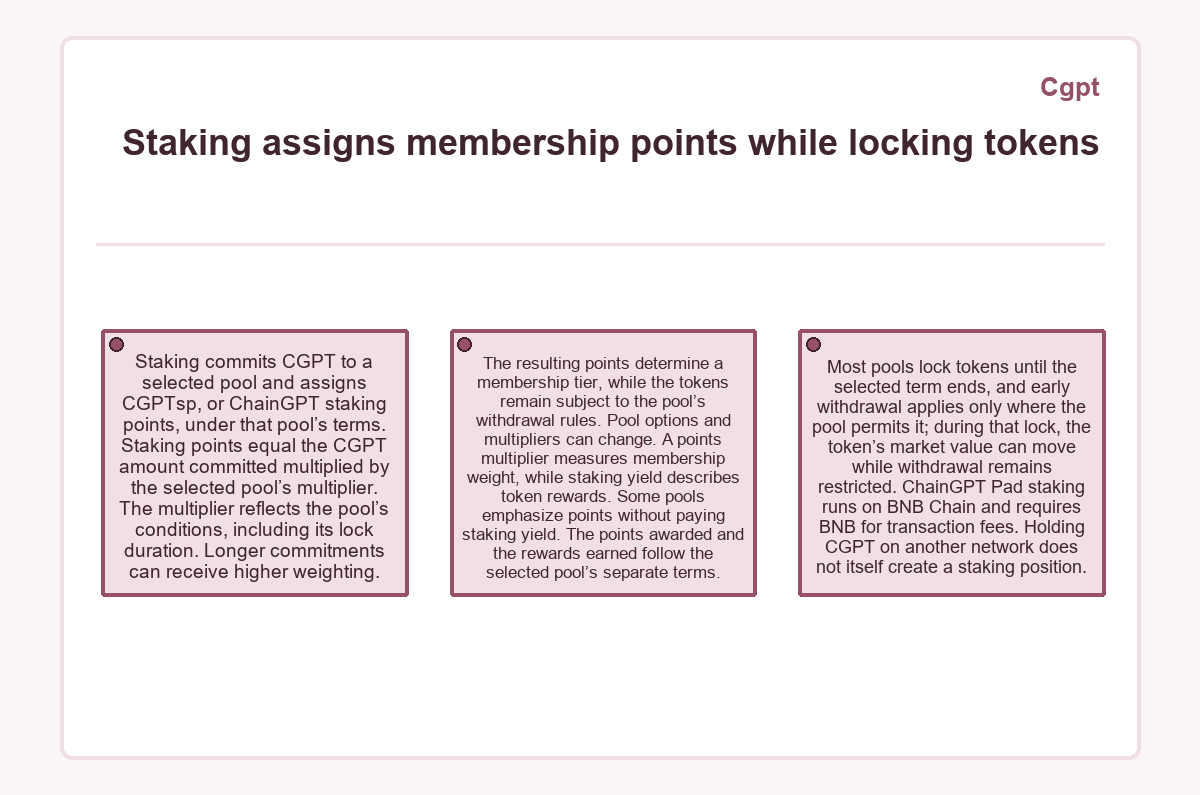
A points multiplier measures membership weight, while staking yield describes token rewards. Some pools emphasize points without paying staking yield. The points awarded and the rewards earned follow the selected pool’s separate terms. Most pools lock tokens until the selected term ends, and early withdrawal applies only where the pool permits it; during that lock, the token’s market value can move while withdrawal remains restricted.
ChainGPT Pad staking runs on BNB Chain and requires BNB for transaction fees. Holding CGPT on another network does not itself create a staking position.
Governance uses staking weight and proposal snapshots
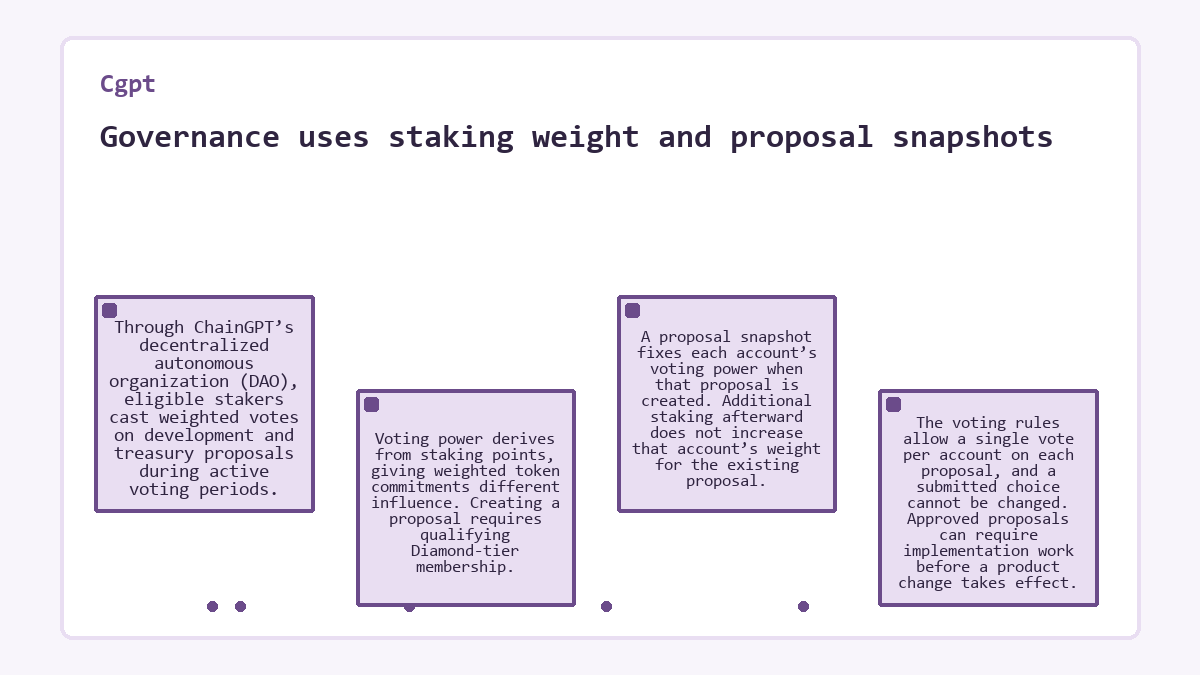
Through ChainGPT’s decentralized autonomous organization (DAO), eligible stakers cast weighted votes on development and treasury proposals during active voting periods. Voting power derives from staking points, giving weighted token commitments different influence. Creating a proposal requires qualifying Diamond-tier membership. A proposal snapshot fixes each account’s voting power when that proposal is created. Additional staking afterward does not increase that account’s weight for the existing proposal. The voting rules allow a single vote per account on each proposal, and a submitted choice cannot be changed. Approved proposals can require implementation work before a product change takes effect.
Does staking CGPT guarantee a token sale allocation?
No; allocation follows the sale format and its eligibility rules, with staking used for tier access or campaign-specific benefits. ChainGPT Pad’s tiered Standard IDO format, an initial decentralized exchange offering, announces purchase limits before buying opens. Access requires identity verification under know your customer (KYC) rules, a qualifying tier and compliance with jurisdiction restrictions. Guaranteed allocation also requires registration. First-come-first-served rounds depend on remaining capacity and campaign eligibility. The accepted purchase currency and transaction fees remain separate from the CGPT stake. Token claiming follows the project’s release schedule, including any vesting.
The Public Sale subscription format admits eligible KYC-approved participants without requiring staking or a tier, subject to jurisdiction restrictions. Allocations are calculated after the sale closes from eligible commitments and any campaign-specific staking boost. Oversubscription can leave part of a commitment unaccepted and refundable. Some campaigns use tier-based fee discounts, so the campaign’s terms govern those benefits. The membership tiers are Bronze, Silver, Gold and Diamond.
Common questions about Cgpt
Can unused Freemium credits carry into the next month?
Unused Freemium allowance does not accumulate across monthly refills. The membership replenishes its credit balance to the plan’s allowance rather than adding another full allowance to the remainder.
Is creating an NFT image the same as minting an NFT?
Generating an image and minting an NFT produce different outputs. ChainGPT’s image generation returns artwork, while minting creates a blockchain token using the chosen metadata and supported network. Minting involves separate blockchain transaction requirements and can incur gas fees. Paying for image generation alone does not establish a minted token.
Where should a ChainGPT API key be stored?
Keep a ChainGPT API key in secure server-side storage, such as a secrets manager or protected environment variable. The key authenticates requests and connects usage to the account. Public browser code and public repositories expose that credential, so the calling application’s backend should load it without sending it to visitors.
Can I delegate staking points to another wallet?
ChainGPT Pad supports delegating staking points to another wallet. The recipient can use delegated points for applicable tier benefits but cannot delegate them onward. The original owner can revoke the delegation, subject to active IDO pool restrictions. Delegation is blocked if either wallet has participated in an active IDO pool, and revocation is blocked while the recipient remains in one. A pool is active from the start of buying until it fills or the buying window ends. This assigns point-based benefits; it does not transfer the underlying staked tokens or replace their withdrawal conditions.
Does liquidity farming count toward DAO voting power?
Liquidity-provider token farming does not grant the DAO voting power associated with eligible CGPT staking. Farming concerns a liquidity position and its rewards, while governance weight comes from the qualifying token stake.